
 DE
DE
 EN
EN

I’ll tell you straight up: if an email has three “synergies” in the first paragraph and a “scale” tacked on at the end, I don’t read to the end. Delete, block, move on. That’s not spite. In all my years running this business, I’ve simply learned that behind the biggest pile of words there’s rarely much benefit — but often a hefty price tag.
I run a metal fabrication business with 22 employees. My rule: orders come first, digital projects second. And when someone wants to sell me something, I read the numbers carefully — I’m unsentimental about that. But the deciding factor is something else. Something most of the sales material that lands on my desk doesn’t even have on its radar.
The one sentence that actually counts with me
Show me a peer who’s already using this — then we’ll talk. That’s not stubborn, that’s careful. If I don’t know anyone in my network who uses a thing like this, the whole pretty feature list means nothing to me. One reference from my trade association outweighs ten glossy folders.
And honestly, that doesn’t make me a special case. Checking what a trustworthy peer does before you decide isn’t just my gut feeling — people who research this sort of thing have looked at it closely. The reason behind it is plain: you want an accurate picture of the situation, and then you act on it. In plain terms: I watch what Huber from the trade association does, because that’s the best information I can get. I’ve known him for twenty years — he won’t talk me into anything.
Now for the honest caveat I’d want to hear from a good salesperson, too: nobody measured this on a metal fabricator from Wels. It was studied in general, on very different people. That it applies to me is plausible — but I won’t sell it to you as proof for my business. I’d rather have an honest qualification than a study that supposedly proves my exact case.
“We’re doing fine without it” is not a dodge
When I’m skeptical about new software, some sales reps hear an excuse. It isn’t one. A lot of my business runs on WhatsApp and Excel, and it works. Changing that costs time, nerves, and money — and the benefit, at first, is nothing but a promise.
And I’m not alone there either. That people disproportionately stick with what they know has been studied for a long time — not just in the lab, but in real, important decisions, like when someone picks a health plan or a retirement program. What that means for you: you’re not selling against my laziness, you’re selling against a very human inertia. And you don’t overcome it with a longer feature list — you overcome it with a reason that outweighs the whole cost of switching. Proven for my business? No, I know that. But it matches everything I’ve seen over the years.
We’re not the exception — we are the market
Sometimes I get the impression half of Austria designs its glossy brochures for a handful of large corporations. Yet 99.7% of all companies in this country are small and medium-sized businesses, and they provide almost two thirds of all jobs. A business like mine isn’t the exception to the rule — it is the rule.
And that rule is far more software-skeptical than most salespeople assume. Look at small businesses across Europe: fewer than half use any ERP software at all, and three out of four have no CRM. At large corporations, all of that has long been standard — but large corporations aren’t the market people like me live in. If your pitch assumes I’m already sitting in some integrated system, you’re talking past my reality. Mine is closer to Excel and WhatsApp. That’s no disgrace — it’s just the starting point you should know before you sell me the next integration.
Talk about my biggest problem, not your selling points
Want to know what really keeps me up at night? Not the missing feature. The missing person. I’m running out of skilled workers — and I’m not alone: 78% of businesses in Austria can’t find the staff they need. Many feel it hard; they have to turn down orders or shrink them, and for some it threatens the business itself. I train apprentices myself, as well as I can — but that doesn’t fill the gap fast enough.
And here in Austria, the squeeze is even tighter than the EU average. Ask anyone from the trade association — they’ll tell you the same story, no report required.
That’s the point where you can actually reach me. If your product helps me get the same work done with fewer people, or frees my few skilled workers from spending their evenings on quotes, timesheets, and delivery notes — then stop saying “efficiency” and tell me exactly that. Concretely, with a business like mine as the example. An honest answer to my biggest everyday problem beats any generic efficiency promise.
What you should talk to me about
I’m not a difficult customer. Just a careful one. I ask three questions about anything new: Do we really need it? Who’s already using it? And what does it cost per year in day-to-day operation — honestly calculated, not dressed up?
Give me straight answers, show me a reference business, and skip the pretty words, and you’ve got a conversation. Sell me synergies and scaling, and you’ve got the trash folder. It’s that simple.
So: show me a peer who uses it. Then we’ll talk.
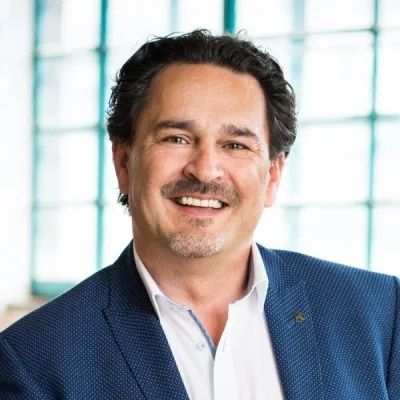 Thomas Kasper
  Julia Neubauer